

Operational KPIs belong in embedded analytics within the ERP system. Strategic KPIs, planning, and company-wide management belong in SAP Analytics Cloud (SAC). If this distinction isn’t clearly made, it leads to duplicate structures rather than transparency.
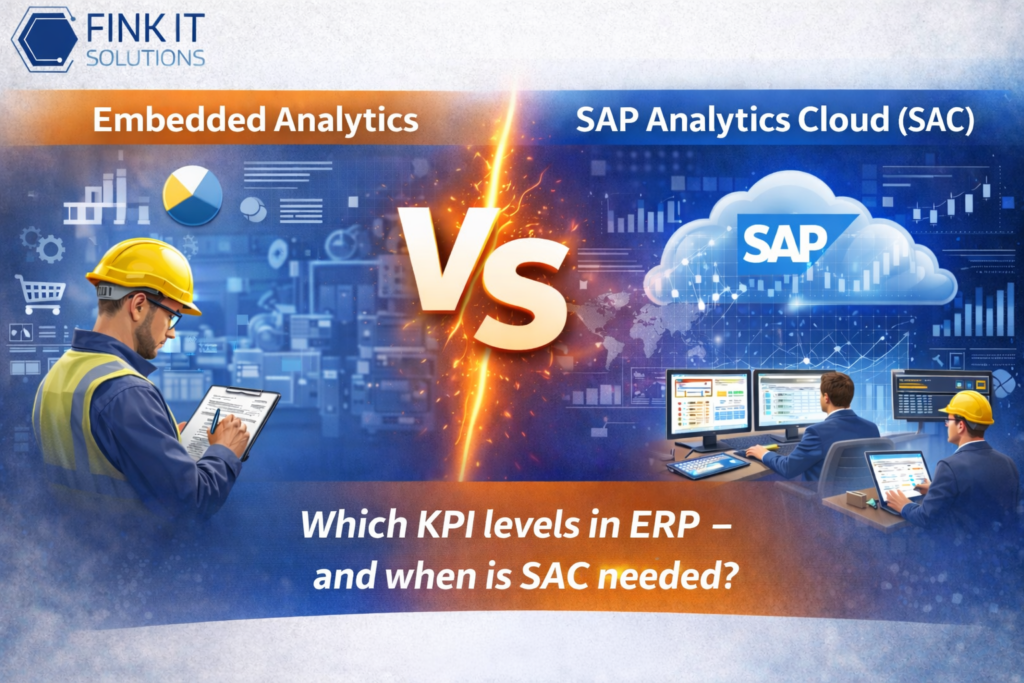
Many companies believe they have a reporting problem—but in reality, they have a structural problem. It’s not about having too little data, but about having too many metrics in the wrong places. Operational KPIs end up in management dashboards, strategic metrics are pulled directly from the ERP, forecasts are created in Excel, and the same metrics appear simultaneously in Fiori, SAP Analytics Cloud (SAC), presentations, and shadow reports. The result is conflicting numbers, unnecessary reconciliations, wasted time, and dwindling trust in the reports.
This is precisely why the discussion surrounding embedded analytics and SAC is so crucial. The central question is not which tool should be used. What matters far more is: Which KPIs must be available directly within the process—and which belong in a central analytics layer for management, planning, and forecasting?
In practice, the bottleneck rarely lies in the technology, but rather in an unclear separation between operational control in the ERP and company-wide control via SAC. Without this clear distinction, duplicate reports, differing KPI definitions, shadow Excel worlds, and manual forecasts arise. Instead of discussing actions, companies then end up debating numbers.
A clear distinction between embedded analytics and SAC provides clarity here. That is precisely what this article is about: how to effectively differentiate between the two, which KPIs belong in the ERP system, when a central analytics layer is necessary, and what role AI will play in this going forward.
Table of contents
- What is Embedded Analytics in SAP ERP?
- What is SAP Analytics Cloud (SAC)?
- Which KPI levels belong where?
- Embedded Analytics vs. SAP Analytics Cloud (SAC) in comparison
- Typical use cases for Embedded Analytics and SAC
- When is Embedded Analytics sufficient – and when is SAP Analytics Cloud needed?
- AI in Embedded Analytics and SAP Analytics Cloud (SAC)
- Best practices for a modern analytics architecture
- Conclusion: using Embedded Analytics and SAP Analytics Cloud correctly
- FAQ
What is Embedded Analytics in SAP ERP?
Embedded Analytics refers to analytical functions that are directly integrated into SAP ERP or SAP S/4HANA. The major advantage is that users work within the process and see their key performance indicators exactly where decisions are made. Analysis and action are directly linked.
For example, a buyer can identify open purchase orders, a production manager can see backlogs, a sales representative can identify at-risk delivery dates, and a controller can analyze variances down to the document or line item level—all without switching systems.
Embedded Analytics demonstrates its strengths wherever operational control, transaction-based KPIs, and evaluations using live data and transaction-based analysis are required. Typical use cases include drilldowns to detailed data as well as decisions made directly within the workflow.
These include metrics such as open orders, delivery delays, backlogs in production or logistics, receivables and processing status, deviations in day-to-day operations, or operational service KPIs. A simple rule of thumb helps with classification: If a KPI is only truly helpful when the user must jump directly into the process, it generally belongs in embedded analytics.
Despite these strengths, embedded analytics has clear limitations. It is not designed to harmonize company-wide KPI definitions, map strategic management controls, or support planning and forecasting. Cross-system analyses also quickly reach their limits in this context.
What is SAP Analytics Cloud (SAC)?
SAP Analytics Cloud (SAC) is a central analytics and planning layer for companies that want to manage operations beyond individual processes. While embedded analytics operates directly within the ERP system and supports operational decisions, SAC ensures that key performance indicators (KPIs) are aggregated and harmonized across departments and made available to management.
Its strength lies wherever a holistic view is required: in management reporting, in company-wide dashboards, and in planning, forecasting, and scenario analyses. SAC makes it possible to standardize KPIs across departments, reveal interrelationships, and make decisions based on a consistent data foundation—even across multiple data sources.
Typical use cases include financial planning, sales forecasts, profit and margin management, cash flow analyses, and group-wide KPI models. Executive board and CFO dashboards, as well as strategic performance management, are also typically mapped in SAC.
It is important to make a clear distinction here: SAP Analytics Cloud is not a replacement for embedded analytics. A common mistake is to pit the two against each other. In fact, SAC complements the process-oriented nature of ERP, but does not replace it. Operational decisions still belong where they are made—directly within the process. SAC builds on this and creates the foundation for cross-functional management.
Which KPI levels belong where?
The distinction between Embedded Analytics and SAP Analytics Cloud (SAC) is less about functionality and more about the type of KPIs. The key question is: at which level does a KPI operate—operational, tactical, or strategic?
Operational KPIs clearly belong in Embedded Analytics. They are transaction-driven, time-critical, and embedded directly in business processes. Their purpose is to enable immediate action. Examples include open orders, delivery dates, backlogs, production utilization, receivables status, or operational escalations. These KPIs deliver their full value only when available directly in the workflow.
Tactical KPIs form the bridge between operational control and management view. They provide aggregated insights and support mid-term steering. Typical examples include monthly revenue by region, cost development per cost center, inventory coverage, backlog ratios per plant, or service levels by business unit. These KPIs can still be handled in Embedded Analytics—provided the data mainly comes from SAP S/4HANA, no complex harmonization is required, and the user group remains limited. However, once multiple systems, entities, or standardized definitions are needed, SAC becomes the more appropriate solution.
Strategic KPIs, on the other hand, clearly belong in SAP Analytics Cloud. They support enterprise-wide steering and require a consolidated, harmonized view of the business. Examples include EBIT, EBITDA, cash flow forecasts, working capital, forecast deviations, budget scenarios, or group-wide performance metrics. These KPIs typically rely on multiple data sources, require consistent definitions, and are closely linked to planning and forecasting—this is exactly where SAC excels as a central analytics and planning layer.
Embedded Analytics vs. SAP Analytics Cloud (SAC) in comparison
Embedded Analytics is the right choice when …
- users work directly within the SAP process
- a KPI is transaction-related
- process proximity is relevant
- drilldowns down to document level are required
- operational decisions are the main focus
SAP Analytics Cloud (SAC) is the right choice when …
- management control is the main focus
- planning and forecasting are required
- multiple data sources need to be combined
- KPI definitions need to be standardized
- cross-functional dashboards are required
The real dividing line:
The key distinction is not:
Embedded Analytics or SAP Analytics Cloud (SAC)?
But rather:
- Embedded Analytics = process control
- SAP Analytics Cloud (SAC) = enterprise management
This is the core logic behind a modern SAP analytics architecture.
Typical use cases for Embedded Analytics and SAC
Use Case 1: Sales
A sales employee wants to identify which orders are at risk and which delivery dates are becoming critical.
Suitable solution: Embedded Analytics
Why?
Because the decision is made directly within the process.
Use Case 2: Production
A production manager wants to identify backlogs, bottlenecks, and scheduling deviations in manufacturing.
Suitable solution: Embedded Analytics
Why?
Because the KPI is only truly actionable within the operational context.
Use Case 3: Financial planning
Finance wants to compare plan, actual, and forecast and simulate different scenarios.
Suitable solution: SAP Analytics Cloud (SAC)
Why?
Because centralized planning, forecasting, and a management view are required here.
Use Case 4: CFO reporting
The CFO needs a consolidated overview of regions, entities, and key figures.
Suitable solution: SAP Analytics Cloud (SAC)
Why?
Because this is about enterprise-wide management, not transaction-level process visibility.
When is Embedded Analytics sufficient – and when is SAP Analytics Cloud needed?
Embedded Analytics is sufficient when …
- the relevant data resides in the ERP system
- decisions are made within the process
- operational control is the focus
- no enterprise-wide KPI harmonization is required
- planning and forecasting do not play a central role
SAP Analytics Cloud (SAC) becomes useful when …
- multiple systems need to be integrated
- management reports are created manually
- Excel acts as the bridge between business units and management
- KPI definitions diverge across departments
- planning and forecasting should be professionalized
A good practical warning sign is:
As soon as Excel becomes the translator between ERP and management, Embedded Analytics is usually no longer sufficient. At that point, a central layer like SAP Analytics Cloud (SAC) is often missing.
AI in Embedded Analytics and SAP Analytics Cloud (SAC)
Artificial intelligence is also transforming the world of Embedded Analytics and SAP Analytics Cloud (SAC). But the same applies here: not every AI function belongs on every level.
AI in Embedded Analytics
In the context of Embedded Analytics, AI is particularly useful when it directly supports the operational user within the process.
Typical examples:
- automatic detection of anomalies
- intelligent alerts for critical deviations
- prioritized case handling
- predictions for delivery delays or bottlenecks
- process-related recommendations for faster decisions
The advantage:
AI in Embedded Analytics can provide support where speed and immediate response matter.
The limitation:
Such AI functions usually remain highly process- and transaction-oriented. They help with operational control but not automatically with enterprise-wide planning or management perspectives.
AI in SAP Analytics Cloud (SAC)
In SAP Analytics Cloud (SAC), AI demonstrates its strengths more at the management and control level.
Typical examples include:
- predictive forecasts to support forecast creation
- scenario simulations and forecasting models with Smart Predict
- Smart Discovery to identify patterns, drivers, and outliers across areas
- Smart Insights for automated explanations of KPI changes
- integrated features for planning support and decision-making
- accelerated analysis in complex management dashboards through intelligent assistance features
The advantage:
AI in SAP Analytics Cloud (SAC) not only helps read numbers but also understand, compare, and anticipate them.
The key distinction in AI
The same basic logic applies to AI as to reporting:
- AI in Embedded Analytics = operational support within the process
- AI in SAP Analytics Cloud (SAC) = analytical support for planning and enterprise management
If these two levels are mixed, unrealistic expectations quickly arise that the respective solution cannot fully meet in practice.
Best practices for a modern analytics architecture
1. Clarify KPI logic first, then select tools
The first question should not be:
What can we build in SAP Analytics Cloud?
The first question must be:
What decision is this KPI supposed to support?
2. Assign KPIs based on decision level
- operational KPIs in Embedded Analytics
- strategic KPIs in SAP Analytics Cloud (SAC)
3. Avoid duplicate structures
The same KPI should not exist in parallel with slightly different logic in ERP, Excel, SAC, and presentations.
4. Establish KPI governance
Every KPI needs:
- definition
- owner
- leading data source
- target audience
- clear purpose
5. Integrate planning deliberately into the target architecture
As soon as planning and forecasting become relevant, Embedded Analytics alone is often no longer sufficient. In that case, SAP Analytics Cloud (SAC) must be deliberately positioned as the central analytics and planning layer.
6. Use AI only where it creates real value
Not every AI function automatically adds value. What matters is whether AI:
- accelerates operational decisions,
- improves management decisions,
- makes forecasts more robust,
- or merely creates additional interpretation effort.
Conclusion: using Embedded Analytics and SAP Analytics Cloud correctly
Embedded Analytics does not replace strategic enterprise management – just as SAP Analytics Cloud (SAC) cannot replace the operational proximity of processes. Both approaches have their clear place, but not on the same level.
As a rule of thumb: operational control belongs in Embedded Analytics, while enterprise-wide management is typically anchored in SAP Analytics Cloud (SAC). This separation will become even more important in the future, as the use of AI raises the additional question of where it creates the greatest value – directly within the process or at the overarching management level.
If this distinction is not implemented cleanly, duplicate reports, inconsistent KPI definitions, and increased coordination effort quickly arise. The result is less trust in the numbers and ultimately slower decision-making.
Therefore, the key question is not what Embedded Analytics or SAP Analytics Cloud can do individually. What matters is where each function is used appropriately from a business perspective.
Find out more and gain practical insights here: SAP Analytics Cloud – Fink IT-Solutions
FAQ
Embedded Analytics supports operational decisions directly within the SAP process.
SAP Analytics Cloud (SAC) supports cross-functional analysis, planning, forecasting, and management control.
Mainly operational, transaction-related metrics such as open orders, delivery delays, backlogs, processing status, or receivables status.
SAP Analytics Cloud (SAC) is useful when multiple data sources need to be integrated, KPI definitions harmonized, management dashboards created, or planning and forecasting need to be integrated.
AI in Embedded Analytics primarily supports operational decisions within the process. AI in SAP Analytics Cloud (SAC) is more focused on forecasting, scenarios, management analyses, and cross-functional evaluations.
No. SAP Analytics Cloud (SAC) complements Embedded Analytics but does not replace the process proximity of operational KPIs in the ERP system.