

ZUGFeRD can be a sensible first step into e-invoicing. However, companies that adopt this format as a permanent solution without establishing a clear SAP DRC or comparable e-invoicing strategy will ultimately pay for the lack of standardization.
This is exactly what we at FINK IT observe time and again across projects: it is not e-invoicing itself that causes the highest costs, but rather operating models based on stopgap solutions, custom logic, and insufficient standardization.
Assessment from FINK IT’s Perspective
Our project experience in the SAP environment reveals a clear pattern: many companies take a pragmatic approach to e-invoicing. This is understandable. They want to become operational quickly, connect with suppliers, and meet legal requirements.
In this phase, ZUGFeRD often appears attractive because it offers a practical middle ground between human readability and machine processing.
However, things become critical when this pragmatic starting point turns into a permanent target state. At this stage, effort, complexity, and operating costs increase significantly—especially if no clear standardization strategy is established within the SAP environment.
At FINK IT, we consistently observe the same symptoms:
- increasing effort to resolve invoice processing issues
- growing maintenance effort for custom logic
- lack of transparency regarding error causes
- high dependency on case-specific knowledge
- increasing burden on business units, IT, and operations
The real cost trap is therefore not ZUGFeRD itself. It arises from the combination of hybrid format logic and the absence of a standardized SAP target architecture.
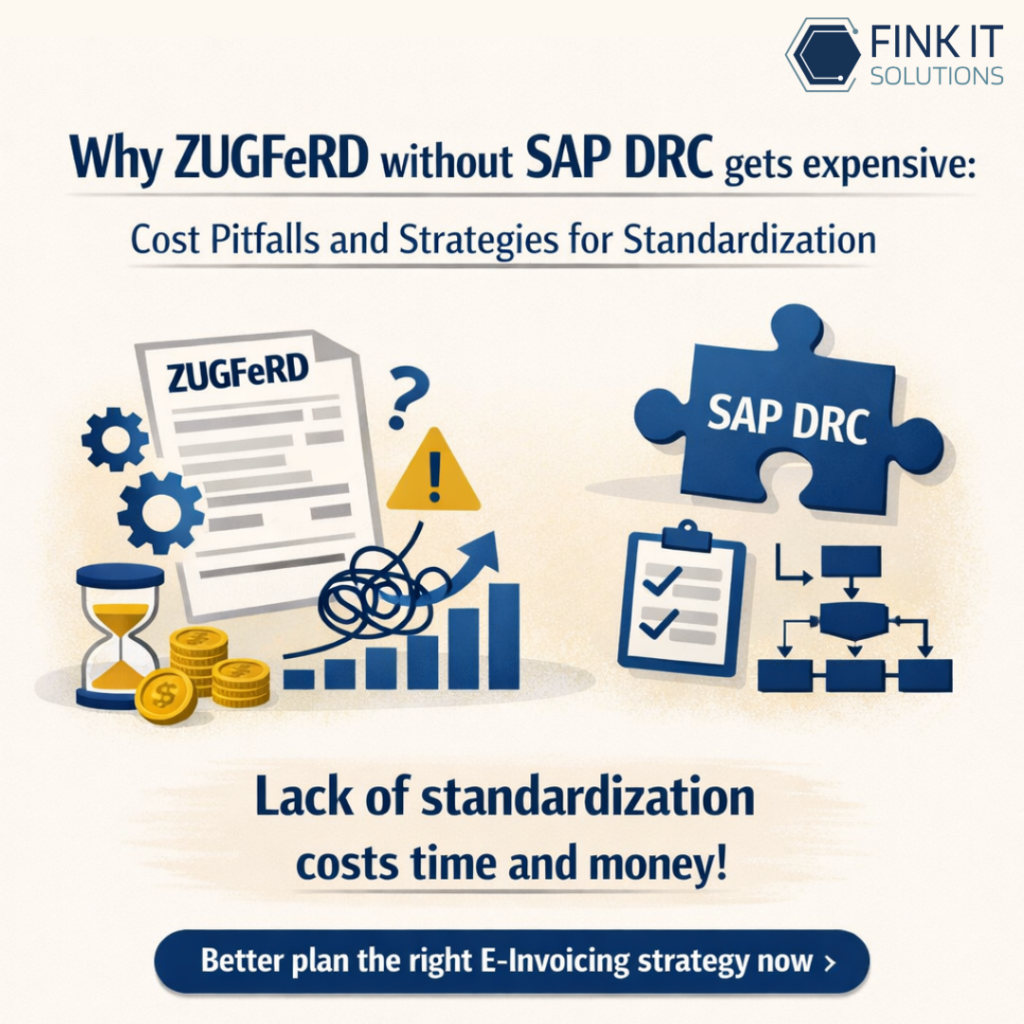
Table of Contents
Why ZUGFeRD initially seems attractive
ZUGFeRD appeals to many companies because it appears to offer a pragmatic compromise. The format combines structured invoice data with a PDF representation, creating the impression that business readability and technical processing can be seamlessly integrated.
This is particularly appealing in early project phases. Accounting teams see a familiar document, suppliers do not need to immediately switch to a fully structured model, and internally there is a sense of having found a quick solution.
From FINK IT’s perspective, this is exactly why ZUGFeRD often serves as an entry point. It becomes problematic when companies turn this initial approach into a permanent operating model.
At that point, the key question shifts from:
“How do we get started quickly?”
to:
“How do we manage increasing volumes, variants, error cases, and integration requirements in the long term?”
And for this second question, ZUGFeRD alone often does not provide an economically viable answer in SAP landscapes.
More interesting blog posts on the topic of e-invoicing:
Where ZUGFeRD becomes expensive in practice
The costs do not arise on day one—they accumulate gradually during operations.
1. Hybrid formats require greater interpretation effort
As soon as a format includes both structured data and a visual layer, coordination and validation efforts increase. In projects, this hybrid logic frequently leads to questions such as:
Which content takes precedence?
Which data is technically processed?
How are discrepancies handled?
Who decides in ambiguous cases?
Even small ambiguities can significantly increase processing costs.
2. Suppliers do not ensure true uniformity
A common misconception is that ZUGFeRD automatically leads to standardized input. In reality, suppliers use different versions, quality levels, and implementations. What appears consistent on paper often behaves inconsistently in practice.
From our experience at FINK IT, this variability is one of the key cost drivers.
3. Error handling becomes costly
When structured data is incomplete or ambiguous, manual processes begin. Invoices are routed into clarification loops instead of standard workflows.
In practice, this leads to:
- more supplier inquiries
- additional manual checks
- coordination between accounting, business units, and IT
- time-consuming error analysis
- special cases in workflows and interfaces
These efforts are costly and hinder standardization.
4. Scaling becomes disproportionately expensive
What works pragmatically at low volumes breaks down as complexity increases. Exceptions and manual steps become structural inefficiencies.
Why the lack of SAP DRC further increases costs
ZUGFeRD alone is not the issue. The real cost driver emerges when SAP DRC—or a comparable target architecture—is missing.
In such cases, there is often no standardized framework for:
- e-document processing
- process integration
- monitoring
- error transparency
- maintainability
- scalable development
Companies then compensate through workarounds: additional tools, custom interfaces, and project-specific solutions. While these may solve short-term issues, they significantly increase long-term operating costs.
Typical consequences without SAP DRC
- increasing interface complexity
- dependence on individual solutions and knowledge holders
- weak monitoring and delayed error detection
- high testing and change effort
- limited scalability
The key question is therefore not whether SAP DRC is a “nice-to-have,” but how standardized, maintainable, and scalable the e-invoicing process should be.
What Companies Should Do Instead
From FINK IT’s perspective, five points are crucial to ensure that e-invoicing does not become an expensive, long-term stopgap solution.
1. View ZUGFeRD as a starting point, not automatically as the end goal
ZUGFeRD can be useful. However, companies should assess early on whether the format is truly economically viable in the long term for their supplier structure, volume, and automation requirements.
2. Define a clear format strategy
Not every open format is an advantage. The process becomes economically viable where clear preferences, binding standards, and defined exception paths exist.
3. Strategically position SAP DRC
SAP DRC should not be viewed in isolation as a technical add-on. What matters is the contribution it makes to the standardization, transparency, and scalability of the overall process.
4. Design error handling with care
Companies should not only plan the “happy path,” but above all define how deviations, incomplete data, and technical errors are handled. This is precisely where the economic viability of a process is determined.
5. Consider operations from the very beginning
An e-invoicing process is only sustainable if implementation, operation, monitoring, and further development are considered together. Those who optimize only the initial implementation often end up building in future costs right from the start.
Conclusion
ZUGFeRD is not inherently flawed. As a starting point, it can be highly useful. It becomes expensive when a temporary solution evolves into a permanent operating model without sufficient standardization in the SAP environment.
From our experience at FINK IT, this is the real cost trap:
not the e-invoice itself, but reliance on hybrid models, manual workarounds, and unclear target architectures.
Companies that use ZUGFeRD long-term without implementing SAP DRC or a comparable strategy will face:
- higher operating costs
- increased error handling
- greater integration complexity
- more complex maintenance
- limited scalability
- growing dependence on custom logic
The economically sound approach is early standardization.
Would you like to assess whether your e-invoicing process in the SAP environment is truly future-proof?
FINK IT can help you evaluate your format strategy, DRC compliance, integration requirements, and operating model to ensure that a pragmatic start doesn’t turn into a costly long-term stopgap solution.
Schedule a consultation today: Meeting mit Niklas Reisinger
FAQ
Is ZUGFeRD fundamentally a bad solution?
No. ZUGFeRD can be a useful starting point. Problems arise when the format shapes the operational model permanently without a clear standardization strategy.
Why does foregoing SAP DRC end up being expensive?
Because important standardization tasks are then often shifted to interfaces, custom developments, and manual processes. This increases operating and maintenance costs in the long term.
Is it sufficient if invoices can be technically accepted?
No. The key factor is whether they can be integrated into the entire SAP process in a stable, transparent, and scalable manner.
What is the most common mistake from FINK-IT’s perspective?
Confusing a pragmatic implementation model with a long-term, sustainable target vision.