

Key Takeaways
The SAP DRC Roadmap 2026 clearly outlines the global direction of e-invoicing and tax compliance: toward real-time reporting systems, increased automation, and globally standardized processes.
With SAP Document and Reporting Compliance (DRC), SAP aims to provide companies with a centralized platform for electronic invoicing, continuous reporting, and regulatory compliance. The SAP DRC roadmap includes new country-specific requirements, AI-powered capabilities, and deeper integration with SAP S/4HANA and SAP BTP.
For organizations, the SAP DRC roadmap sends a clear message: now is the time to future-proof architecture, processes, and compliance strategy.
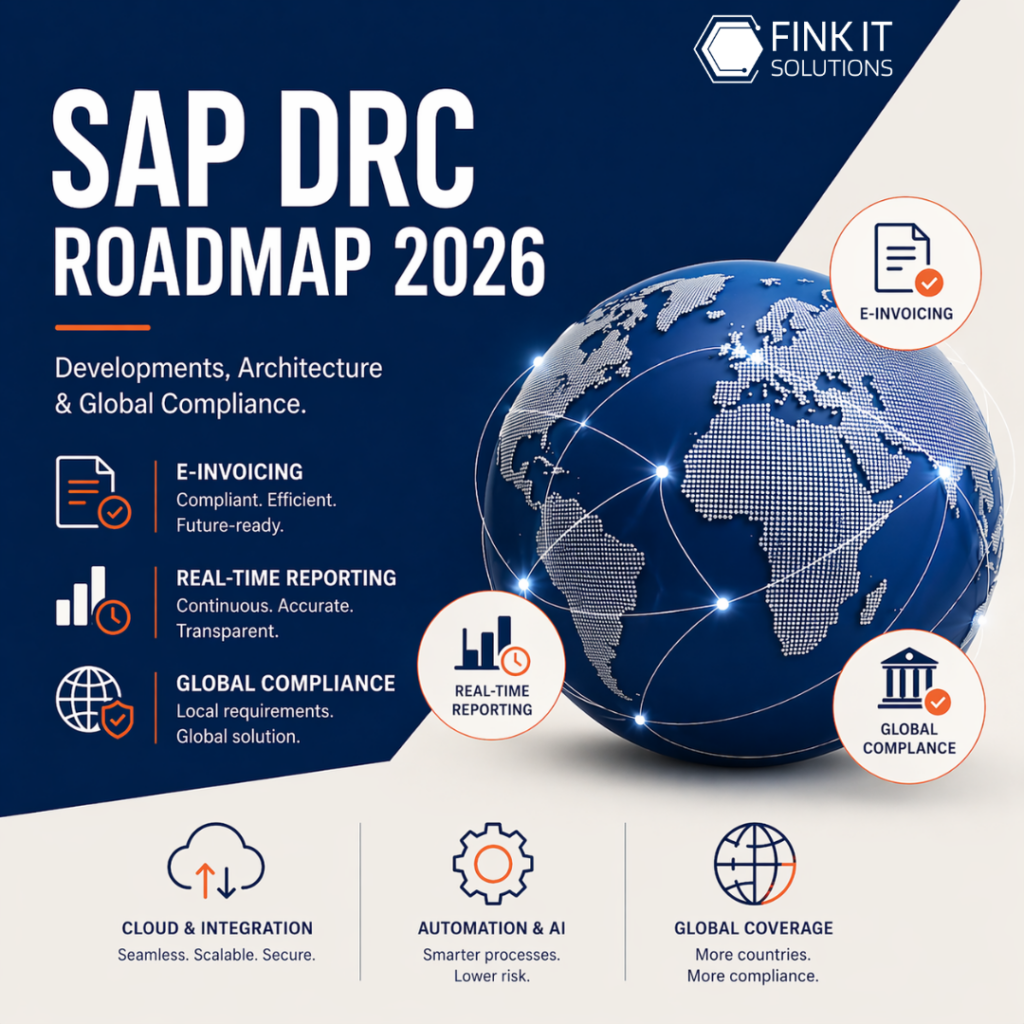
Table of Contents
- What does the SAP DRC Roadmap 2026 include and what new features are planned?
- Which countries and regulatory requirements are covered?
- How does SAP DRC support global e-invoicing and compliance through 2026?
- What role does SAP DRC play in the 2026 e-invoicing strategy?
- What does the target architecture for SAP DRC look like in 2026?
- What integration options does SAP DRC offer?
- Conclusion & Outlook
- FAQ
- Useful Links & Sources
What does the SAP DRC Roadmap 2026 include and what new features are planned?
The SAP DRC roadmap demonstrates a clear evolution toward greater automation, scalability, and intelligence.
Key innovations include:
- Expansion of e-invoicing and reporting functionalities
- Integration of GenAI for error analysis and compliance optimization
- Automated generation and adaptation of statutory reports
- Enhanced support for multi-system landscapes
The primary focus is on automating compliance processes and minimizing risks through intelligent analytics.
The roadmap makes it clear: compliance will become increasingly data-driven, automated, and globally standardized.
Which countries and regulatory requirements are covered?
A core element of the SAP DRC roadmap is the continuous expansion of country coverage.
SAP DRC already supports 55+ countries and 500+ scenarios.
The 2026 roadmap includes, among others:
- Mandatory B2B e-invoicing mandates (e.g., Poland, France, Belgium)
- Enhancements for real-time reporting systems
- New requirements in the area of SAF-T and continuous reporting
Additionally, countries such as Greece, Bulgaria, and Malaysia are planned.
This positions SAP DRC as a global platform for tax compliance.
How does SAP DRC support global e-invoicing and compliance through 2026?
The SAP DRC roadmap aims to provide a unified global solution.
Key capabilities include:
- Centralized control of all e-invoicing processes
- Automated communication with authorities
- Real-time invoice validation
- Full audit trail and traceability
According to SAP, the solution enables seamless integration between business processes and regulatory requirements.
Further insights:
👉 E-invoicing with SAP | PEPPOL | X-Rechnung | ZUGFeRD – Fink IT-Solutions
👉 SAP Invoice Management: SAP VIM Explained & Benefits
SAP DRC enables companies to implement compliance efficiently and at scale.
What role does SAP DRC play in the 2026 e-invoicing strategy?
The SAP DRC roadmap positions DRC as a central platform for:
- E-invoicing
- Continuous Transaction Controls (CTC)
- Statutory reporting
SAP DRC acts as a global compliance hub that:
- Transforms data
- Provides legally compliant formats
- Automates communication with authorities
More details:
👉 SAP Document and Reporting Compliance – Fink IT-Solutions
The roadmap clearly shows: without a centralized platform, managing global compliance will become increasingly complex.
What does the target architecture for SAP DRC look like in 2026?
The target architecture is based on a cloud-first approach:
- SAP Document and Reporting Compliance (Cloud Edition)
- SAP Business Technology Platform (BTP)
- SAP Integration Suite
This architecture enables:
- Scalable integration across systems
- Centralized control of all compliance processes
- Flexible extensibility
SAP DRC acts as a central layer between SAP systems and authorities.
The roadmap clearly emphasizes cloud-first and platform integration.
What integration options does SAP DRC offer?
The SAP DRC roadmap strongly focuses on integration:
- SAP S/4HANA (Public & Private Cloud)
- SAP ERP
- SAP Business Network
- Third-party systems (e.g., billing systems)
A key advantage:
Non-SAP systems can also be integrated via standardized interfaces and formats such as UBL.
Integration is a critical success factor.
Conclusion & Outlook
The SAP DRC Roadmap 2026 clearly shows that compliance and e-invoicing are undergoing fundamental transformation.
Companies should prepare for:
- Real-time reporting becoming the standard
- Increasing global regulatory requirements
- Growing importance of automation and AI
The SAP DRC roadmap provides the technological foundation for this shift.
Early adopters can secure competitive advantages and minimize compliance risks.
FAQ
How does SAP DRC support real-time reporting?
By integrating continuous reporting systems that enable direct communication with authorities.
What AI and GenAI capabilities are included?
-> Automated error analysis
-> Trend analysis for risk reduction
-> AI-supported report generation
How can international rollouts be managed?
Through centralized control, standardization, and country-specific adaptations.
Useful Links & Sources
SAP Document and Reporting Compliance | SAP Community
SAP Help Portal | SAP Online Help
SAP Document and Reporting Compliance: Aktuelle Entwicklungen, regulatorische Treiber und strategischer Handlungsbedarf für Unternehmen (2025–2026) – INSIRE